

Solution
LEWA pumps are used in a wide variety of processes for the production of biodiesel and other biofuels.
Depending on the particular application, different pumps that optimally meet the respective requirements are used:
- Conventional process for producing biodiesel with LEWA ecosmart pumps for metering of additives (up to 300 l/h, up to 80 bar, ambient temperature)
- Alternative process for producing synthetic fuels with LEWA ecoflow or LEWA triplex as high-temperature process pump for increasing reactor pressure (15 m³/h, up to 250 bar, up to 350 °C)
- Esterification of organic fats or oils with methanol in the high-pressure process with LEWA triplex, process pump as feed pump for oil or methanol, (100 to 2400 l/h, up to 250 bar, up to 100°C)
- Thermal decomposition of organic waste with a LEWA metering pump as feed pump for biomass (100 l/h, up to 320 bar), ambient temperature and a recirculation pump (250 bar, 350 °C)
- Newly developed synthesis process for the Bioliq® pilot system at KIT Karlsruhe with various LEWA metering pumps and high-temperature pumps
Areas of application
LEWA pumps in various processes for biofuel production:
Illustration
Process description
Process
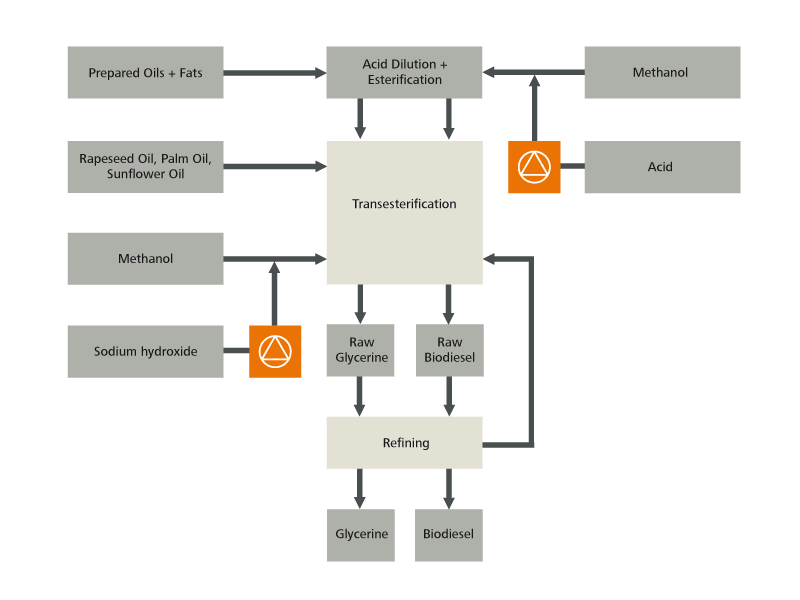
Conventional process for biodiesel production: Esterification of vegetable oils with methanol.
Low pressure 1st generation
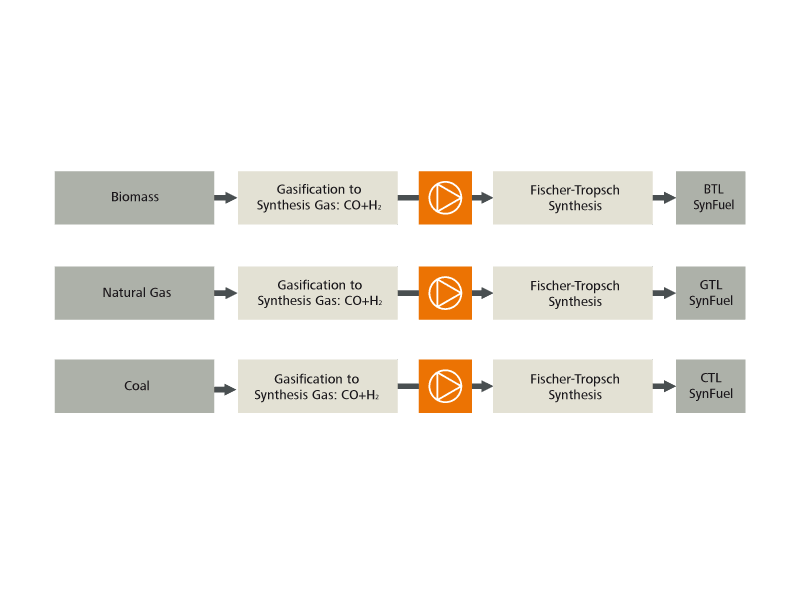
Alternative process for synthetic fuel production:
Gasification of carbon-containing raw materials for the production of synthetic gas (CO+H2), which is subsequently converted into a long-chained fuel using Fischer-Tropsch synthesis. In the last process step (hydrocracking), the desired BTL fuel (synfuel) is generated at temperatures < 200°C and a process pressure up to 90 bar.
For more information about this, visit: www.bioliq.de
High pressure 2nd generation
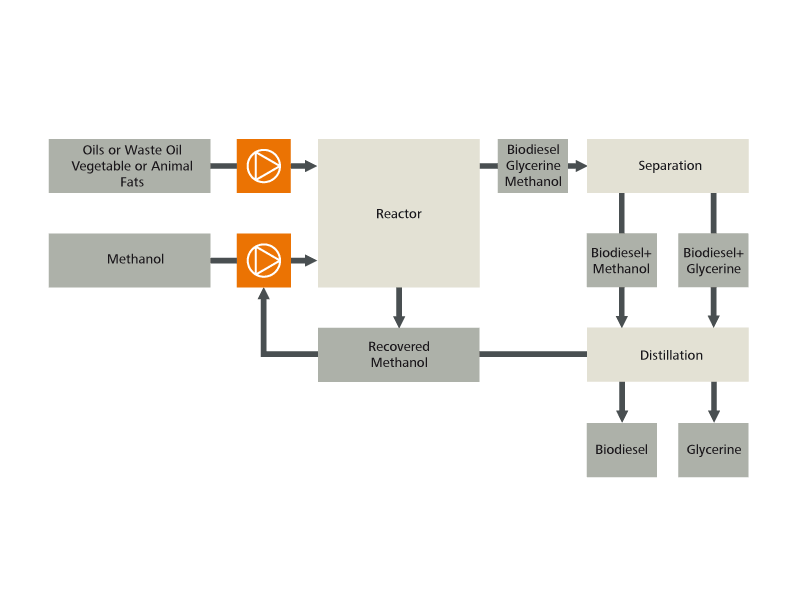
Similar process (conventional)
Esterification of organic fats or oils with methanol in a high-pressure process.
High pressure 2nd generation
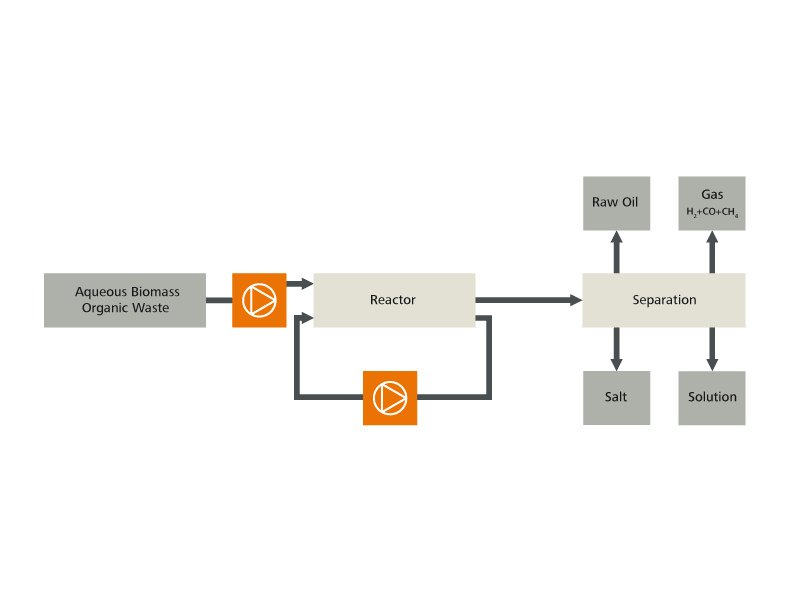
Thermal decomposition of organic waste for the production of crude oil with a low boiling point as well as gas with a high hydrogen content.
High pressure 2nd or 3rd generation
Background
The use of biofuels offers significant advantages in comparison to fossil energy sources:
- Environmentally friendly by reducing CO2 emissions in accordance with the Kyoto Protocol
- Excess capacities of industrial agriculture can be used sensibly
- Political independence from oil states, global availability of the raw material
- Can be used with current and future engine technology, because production of a synthetic fuel can be "customized"
Biofuel production 1st generation:
Vegetable-oil-based fuels
| Source | Fuels | Targets |
|---|---|---|
Oil-bearing plants from agriculture production:
|
|
|
Biofuel production 1st generation:
Bioethanol:
| Source | Fuels | Targets |
|---|---|---|
Renewable resources
|
|
|
Biofuel production 2nd generation:
Synthetic fuels (synfuels):
| Source | Fuels | Targets |
|---|---|---|
Gasification of renewable resources, biogenic and renewable residual materials:
|
|
|
Biofuel production 3rd generation:
Hydrogen
| Source | Fuels | Targets |
|---|---|---|
| From biomass through thermochemical and microbiological processes as well as from electrolysis, powered by photovoltaic systems and wind power plants. |
|
|
Legend:
| Term | Description |
|---|---|
| Biofuels: Synfuels: BTL: GTL: CTL: CNG: LPG: ETBE: FAME: RME: | Renewable fuels and propellants Designer fuels Biomass to liquid Gas to liquid Coal to liquid Compressed natural gas Liquefied petroleum/propane gas Ethanol tertiary butyl ether Fatty acid methyl ester Raps methyl ester |